Photogrammetry: Preservation and Reconstruction
Virtual Modelling of a Thirteenth–Century Pedestal
from Byford Church, Herefordshire
John Steer modellinghistory.com
- Page Contents
- Photogrammetry
- Videos of the Virtual Model
- Reconstruction
- Footnotes
Note: Further research since this report was first written suggests another possibility for the moulded stone. At Dore Abbey there is a smaller disassembled arch that rested on capitals of a not dissimilar size and period. This is being considered and the report will be updated accordingly. For the time being the report continues to suggest that the stone is a pedestal.
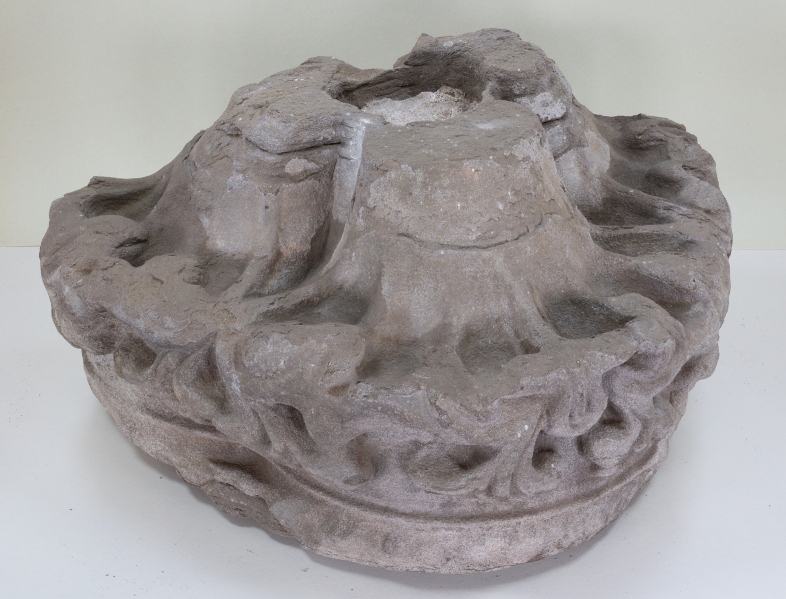
Fig. 1. A photograph of the moulded stone pictured upside down, it measures: width 38cm, height:19cm and depth (from back to front) 30cm.
The Pedestal
Pictured left is a moulded stone placed in the porch of Byford church, for at least sixty years1, more likely ninety and probably longer, according to the few mentions it has. It was placed upside-down, the top being broader than the base, and called a capital - the top of a column - in those mentions. Clarke2, 1949, adding tentatively that the stone could be part of an old font, the present one in the church dating from 1638. There is agreement that it is a 'stiff–leaf' moulding dating from the thirteenth–century.
The top could be assumed flat and the shape of its supporting pillar can be determined from the base as three colonettes, each round in section placed around a central circular column. When compared to the arch supporting columns and capital of the same age in the church it is much smaller and the width of the column is too insubstantial for a capital supporting any great weight such as a large building arch. The top is not circular and difficult to imagine as part of a font.
There is great variation in the executions of stiff–leaf mouldings. There is no one definitive pattern though it could be expected that individual masons would produce similarly styled pieces. Byford church has three in situ stiff–leaf mouldings, each a springing point of the two arches of the thirteenth–century arcade between the chancel and south transept (Figs. 2 & 3 below). The central one is the capital of a column, the eastern the capital of the respond column, and the western a corbel set into the wall to carry the weight of the arch. The eastern respond capital (Fig. 2) is the closest in style to the moulded stone though there are significant differences in the structure. The supporting column is far more substantial. The abacus, the flat top part, widens out which is usual for a capital, whereas the top of the stone reduces in width (see videos below).
The suggestion here is that the stone is a pedestal on which a free standing object such as a statue was placed.
It was moulded from a local sandstone which being a sedimentary rock deposited in thin layers over time has the disadvantage of these layers separating; the stone shows evidence of this. Softer sandstones are further susceptible to erosion and there is loss of parts through wear and tear or previous handling.
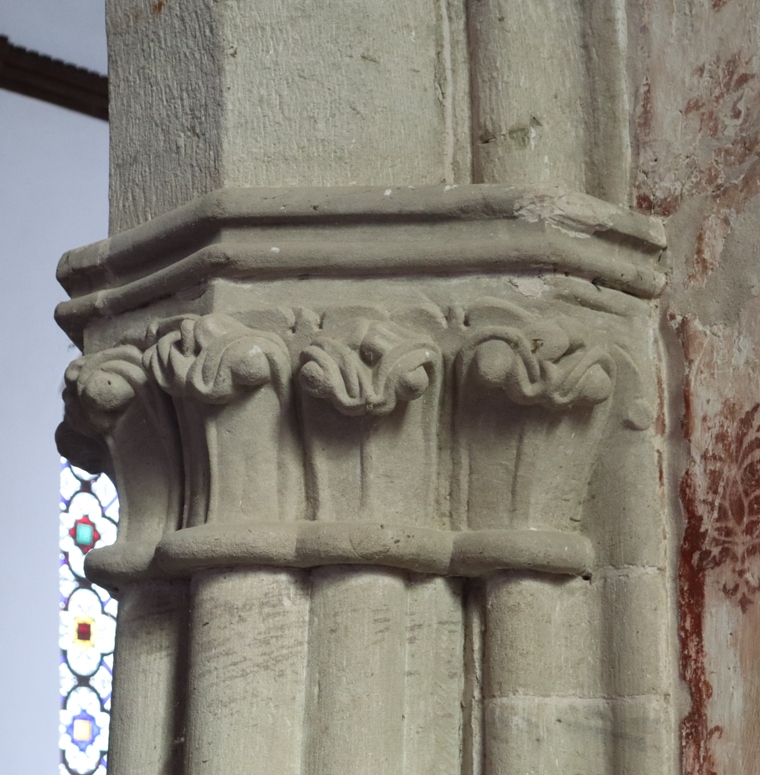
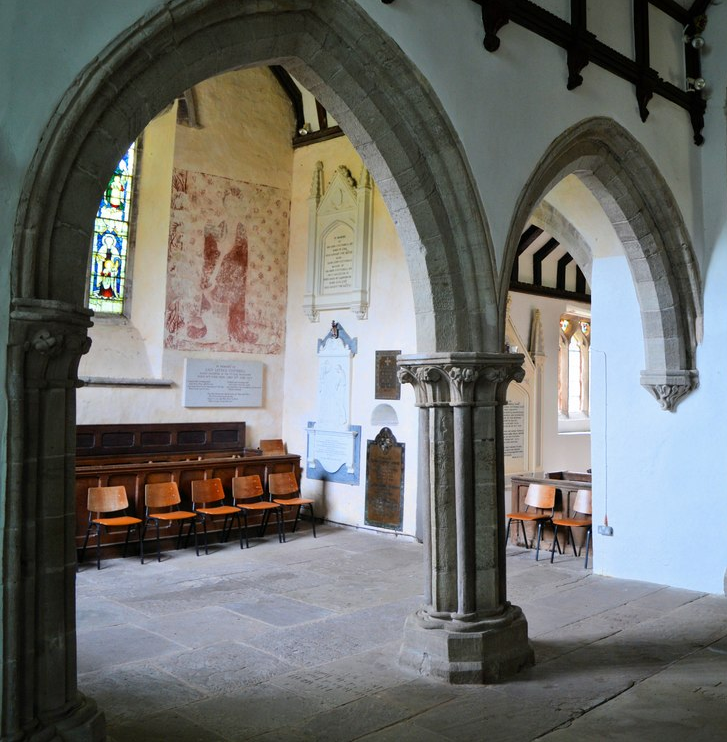
Figs. 2 & 3. The two arches of the arcade between the chancel and the transept is shown above right. The three supports (seen left to right in the image) are: the eastern respond, the central pillar and western corbel. Apart from the corbel, the capitals have stiff–leaf thirteenth–century mouldings, with the eastern respond (detail above left) closest in appearance to the moulded stone. The corbel closer to an earlier flat–leaf design but with interwoven leaf stems.
Photogrammetry
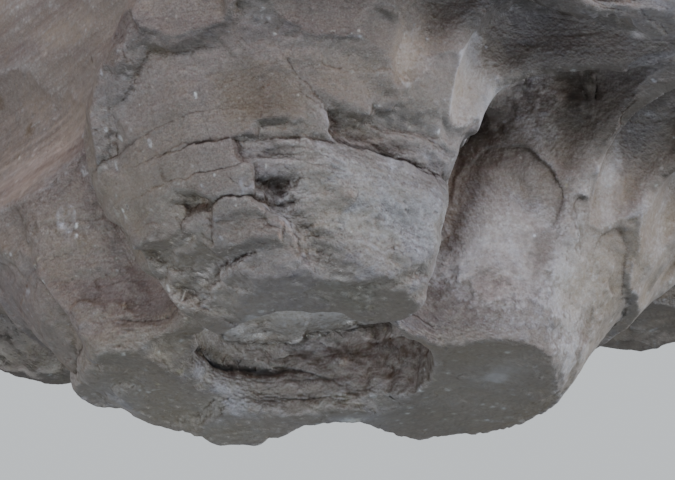
Fig. 4. Detail from the evaluation virtual model of the stone showing that the deteriorated base may no longer be able safely to support the weight of the stone. The visible fractures could worsen easily leading to large parts breaking away.
Studying the stone in detail would require further handling risking more damage particularly as it is heavy. An alternative is to minimise these risks by producing a detailed and accurate virtual model of the stone using photogrammetry. There would need to be some handling but kept to a safe minimum. With permission the stone was removed to create the virtual model.
Photogrammetry is the creative art of forming virtual models from photographs. The quality and quantity of photographs are both important so that the specialist computer software is not distracted or confused, and has sufficient views of an object to visualise a model. Harsh shadows and extra objects in the images are to be avoided by the choice of lighting and backgrounds; photographic studios are preferred where possible in cases such as the moulded stone.
Making a virtual model has advantages.
- The model is a preservation record of the object in its present state when further deterioration is likely.
- The object can be studied without repeated handling which is important where an object is heavy or fragile.
- Damaged or missing parts can be computer modelled and the object placed in a virtual historical scene.
- 3D printing may be appropriate to produce replicas.
- An accurate model makes it more difficult to trade an object in the antiquities market in the event of theft.
The stone was first assessed as suitable for studio work. It could safely be placed upside down as it had been, but the clear damage to the base prevents it from being turned upright. The stone was placed on strong conservation foam to avoid friction between the flat top and the studio floor. An evaluation photogrammetric virtual model was created of the underside, which confirmed that if it was inverted the base would be unlikely to support the weight without further shearing of the sandstone layers (Fig. 4). Splitting of these layers was already advanced in places. However, the examination model showed the possibility that the stone could be laid on its back to allow photographs to be taken of the top. Altogether over two hundred photographs were taken resulting in a detailed model of the stone.
The photogrammetry was successful and a detailed and accurate virtual model of the moulded stone in its present condition has been created. The model can be used for further study and assessment of the stone. Initially two simple 'turntable' videos have been produced (available below):
- The viewing of the stone is restricted to what the videos display, the user cannot change the viewing angles. An adaptation of the model will allow users to rotate the model and zoom in and out.
- The missing column has been recreated (below) through computer modelling. The colonettes that supported the pedestal were modelled as inferred by the base of the pedestal. It is not intended to reconstruct missing parts of the stiff–leaf moulding.
Videos of the Virtual Model
Two 'turntable' videos are presented of the virtual model of the stone, one showing the top and the stiff–leaf moulding and the second details of the base. They are best viewed full screen and can be stopped at any point to observe details.
The back is curved so possibly designed not to be placed against a flat wall. The horizontal lines of the sedimentary layers are clearly seen on the back.
Reconstruction
An advantage of virtual models is that they can be manipulated and examined but also dissected to reveal profiles. A virtual section across the pedestal above most of the damaged base revealed new details of the moulding (Fig. 5.).
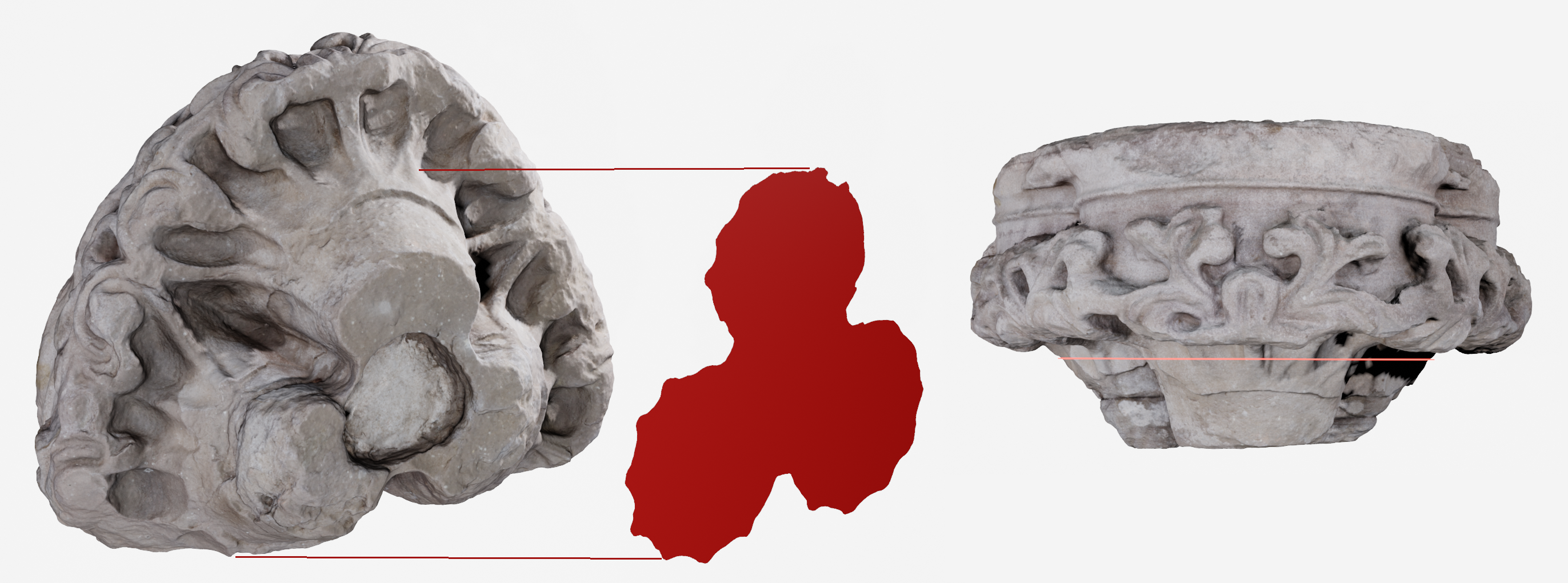
Fig. 5. Images taken from the virtual model. Above left is the underside of the stone showing the flat base where it rested on a pillar. The flat base has three lobes indicating that the shape of the pillar was of three circular colonettes, and from the base of the stone it is seen that the colonettes were connected together. Erosion and damage has affected the shape and true size of the lobes. The thin red line on the image to the right is positioned above most of the damage, and there, using the model, a virtual cross–section was taken across the stone. The shape of the section is shown centrally in red revealing the fluting around the lobes. Although damaged the base of the stone has enough detail to show that the fluting dies away as it tapers towards the colonettes, and that these were not actually truly circular. The large central hole in the stone is a mortice to house a protruding tenon in the now missing pillar.
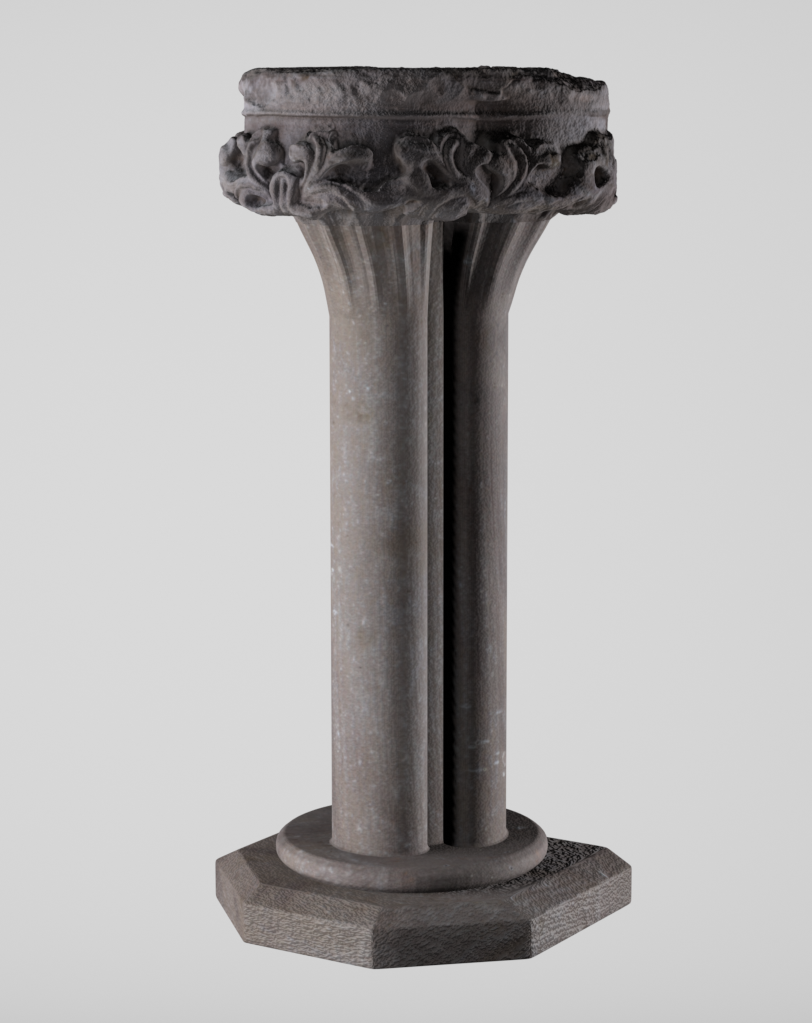
Fig. 6. The pedestal placed on a reconstruction of a supporting pillar.
A reconstruction of the pillar was made starting from the cross–section (shown red in Fig. 5.). It was extended downwards, tapering in and with the fluting dying away at the point where the pillar becomes properly vertical. It is not clear how far down the tapering the fluting continued, some flutes appear to die away quickly with others persisting for longer. The pillar is comprised of three touching, near circular, colonettes. The shape of the base is unknown and has been modelled on similarly dated masonry (Fig. 6.).
The pedestal together with the pillar is top–heavy which would have affected its stability, the more so the greater the height of the pillar. Instability would increase when a statue was in place. The pillar may have been shorter than shown here, and may not even have been standing on a floor. It may have been part of a larger set of mouldings, though there is no indication on the pedestal itself that it was connected to anything else, apart from resting on a pillar.
It would help to find a similar pedestal of the same date still in place in some church, though the chances of this are reduced. The pedestal dates from the Catholic era when religious statues and images were a central part of worship. The Protestant reformation begun in Henry VIII’s sixteenth–century rule regarded these as idolatrous, and their destruction in churches really began systematically in the reign of Henry’s son Edward VI. Although Edward was followed by the Catholic Queen Mary, her reign was the last of official Catholicism, and subsequently destruction of statues and images recommenced mostly in the following century under the Puritans. The fifteenth–century wall paintings in the south transept of Byford church would have been whitewashed over during those times.
Footnotes
1 In 1934 the RCHM notes "In S. Porch capital with 'stiff–leaf'", with the said capital possibly referring to the pedestal. Pevsner, 1963, records "There was more stiff–leaf than in situ now, see the two rich fragments in the porch", nothing is known about another piece and the RCHM made no mention of it.
Royal Commission on Historical Monuments of England Survey, "An Inventory of the Historical Monuments in Herefordshire, Volume 3, North West", His Majesty's Stationery Office, London, 1934, pp30–32.
Available on–line https://www.british-history.ac.uk/rchme/heref/vol3
Pevsner, Nikolaus, "The Buildings of England / Herefordshire", 1963, Penguin Books Ltd.
2 Clarke, Rev. B.B., Rector, "The architecture of Byford Church", available online Transactions of the Woolhope Naturalist's Field Club, Herefordshire, Volume XXXIII, 1949, p19.